


Hey you!
Welcome back to “that’s what she said”, the newsletter that explains web3 without making you feel like you need a PhD in cryptography and three cups of espresso just to keep up. Last time, we broke down blockchain basics and how it all works (if you missed it, go get your homework done before the teacher finds out).
Today, we're going full degen mode and diving deep under the hood. If blockchain basics gave you the driver's license, consider this your Formula 1 engineering course. We're about to explore the architecture that makes blockchain tick, from scalability challenges to the complex layers that work together like a perfectly orchestrated symphony. This might get technical, but I promise to keep it as digestible as your favourite midnight snack 😏
Ready to see what's powering the future of the internet? Let's dive in.
⚡Blockchain Scalability
Do you remember Visa, the world's largest payment system? I guess, yes. We are talking about it now because Visa can process over 65,000 transactions per second during peak times, which makes it one of the fastest payment infrastructures. You may ask — what about Bitcoin? Bitcoin can handle only 4 to 7 transactions per second. That's like comparing a bicycle to a spaceship.
This massive gap reveals blockchain's biggest challenge — scalability.
Blockchain scalability refers to a network's ability to handle an increasing number of transactions efficiently. It's measured primarily in TPS (transactions per second), a metric that determines whether a blockchain can actually serve real-world demand or just remain a cool tech experiment.
Scaling a blockchain isn't as simple as adding more servers like traditional tech companies do. The distributed nature of blockchain creates unique constraints that require innovative solutions. You can't just throw more hardware at the problem and call it a day.
⚖️ Scalability Trilemma
The Blockchain Scalability Trilemma, a term coined by Vitalik Buterin (Ethereum co-founder), describes the three properties a high-performing blockchain must have:
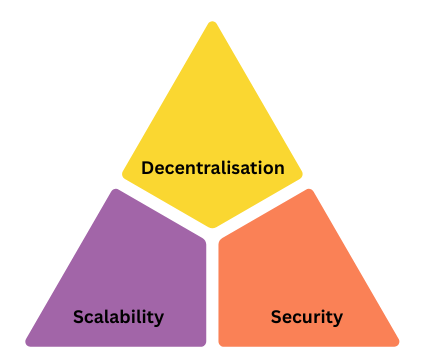
The core idea of this trilemma is that a blockchain can only achieve two of these three goals simultaneously. We've already covered the concept of scalability, so let's also clearly define what the rest of the properties are.
Decentralisation is the elimination of intermediaries and central control. In a truly decentralised network, no single entity can control, censor, or manipulate the system. Power is distributed across thousands of independent participants worldwide.
Achieving optimal decentralisation often reduces network speed. As more miners or validators join to secure the network, transaction processing can slow down because more participants need to reach consensus.
Security means protection against attacks, fraud, and manipulation. It's about ensuring that the network remains trustworthy and resistant to malicious actors trying to game the system.
The distributed nature of blockchain inherently provides security: instead of attacking one central database, hackers would need to compromise the majority of the network simultaneously. However, increasing throughput often involves reducing the number of nodes or their geographical distribution, which can compromise security.
So, the trilemma suggests that prioritising one property often requires sacrificing some degree of other properties:
- Want to be super secure and decentralised? You’ll sacrifice speed (hi, Bitcoin).
- Want to be fast and secure? You’ll probably centralise control (hello, some private blockchains).
- Want to be fast and decentralised? Security takes a hit (and hackers say thank you).
This is why solutions like Layer 2 networks exist. They’re essentially upgrades to boost speed without wrecking the blockchain’s core principles. We'll discuss what Layer 2 means further in this article. Let's get going!
🦀 Functional Layers
When discussing blockchain architecture, there are two types of layers: functional layers and blockchain layers. Functional layers are the core components that determine a blockchain's basic operations, security, and application support.
Think of blockchain as a layered cake: each layer serves a specific purpose, and together they create the complete system we know and love. Let's see what those layers are.
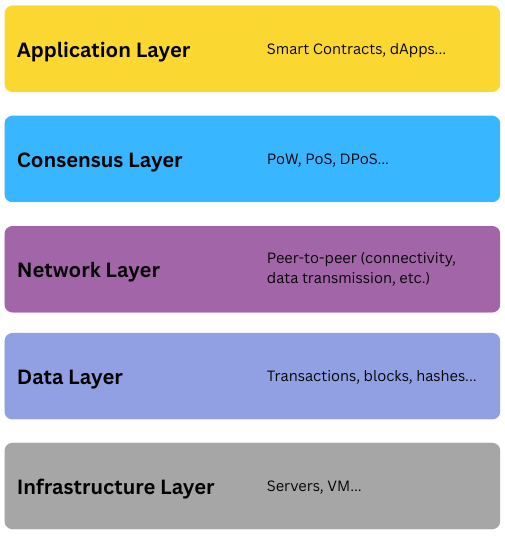
Hardware/Infrastructure Layer
This is the foundation, the physical world where blockchain meets reality. It includes all the servers, computers, mining equipment, and internet infrastructure that power the network.
This layer also hosts virtual machines — specialised environments that execute smart contracts. Every major blockchain has its own: Ethereum Virtual Machine (EVM) for Ethereum, Avalanche Virtual Machine for Avalanche, and so on.
Data Layer
Here's where all the magic happens with data storage and structure. This layer organises transactions into blocks and chains them together using cryptographic hash functions.
The data layer also defines the cryptographic primitives like digital signatures, public-private key pairs, and encryption algorithms that keep everything secure.
Network Layer
This layer manages communication between all the computers (nodes) in the network. It's responsible for:
- Peer discovery (how nodes find each other)
- Data transmission protocols
- Maintaining network connectivity
- Managing node sessions and authentication
Without this layer, blockchain would just be isolated computers talking to themselves, not very useful for a distributed system.
Consensus Layer
This is where democracy happens. The consensus layer establishes the rules for how network participants agree on the validity of transactions. Different blockchains use different mechanisms, and there are some of them:
- Proof-of-Work (PoW): Miners compete to solve mathematical puzzles.
- Proof-of-Stake (PoS): Validators are chosen based on their stake in the network.
- Delegated Proof-of-Stake (DPoS): Token holders vote for representatives who validate transactions.
We'll discuss the consensus mechanisms in more detail in the upcoming articles.
Application Layer
This is what users interact with — wallets, decentralised exchanges, NFT marketplaces, and other dApps. It's the interface between the complex underlying technology and human users.
Smart contracts live here, too. A reminder: they are programmable code that automatically executes agreements when specific conditions are met. They're like digital vending machines: insert the right input, get the predetermined output.
Here is a scheme below, so you can better remember the functional layers:
🏗 Architecture Layers
Blockchain functional layers work together to form what are known as blockchain architecture layers. This is what we refer to when we call Layer 1, 2 and 3 blockchains.
While functional layers show us how blockchain works internally, architecture layers represent different approaches to solving the scalability trilemma.
Layer 0 (L0): The Foundation
This layer provides the underlying infrastructure that enables multiple blockchains to operate and communicate. Think of it as the internet for blockchains – the foundation that allows different networks to interact.
Examples include cross-chain protocols and the basic internet infrastructure that supports blockchain networks.
Layer 1 (L1): The Main Chain
L1 blockchains are the primary networks where the core blockchain functionality happens. These are the "mother ships" like Bitcoin, Ethereum, Solana, Cardano, and others.
They handle:
- Transaction processing and validation
- Consensus mechanisms
- Network security
- Base-level functionality
L1s typically excel at security and decentralisation but struggle with scalability due to the trilemma constraints.
Layer 2 (L2): The Scaling Solutions
L2 solutions are built on top of Layer 1 blockchains to enhance performance without compromising the main chain's security. They process transactions faster and cheaper while maintaining a connection to the main network.
Popular L2 approaches include rollups (zkSync, Optimism), state channels (Lightning Network), nested blockchains, and others. We'll discuss scaling solutions in the upcoming articles.
Layer 3 (L3): The User Experience
L3 focuses on applications and user interfaces. It's where blockchain technology becomes accessible to regular people through user-friendly apps, cross-chain applications, and APIs.
This layer abstracts away the complexity of the underlying blockchain infrastructure, allowing users to interact with web3 without needing to understand the technical details.
🛠 Web3 Stack
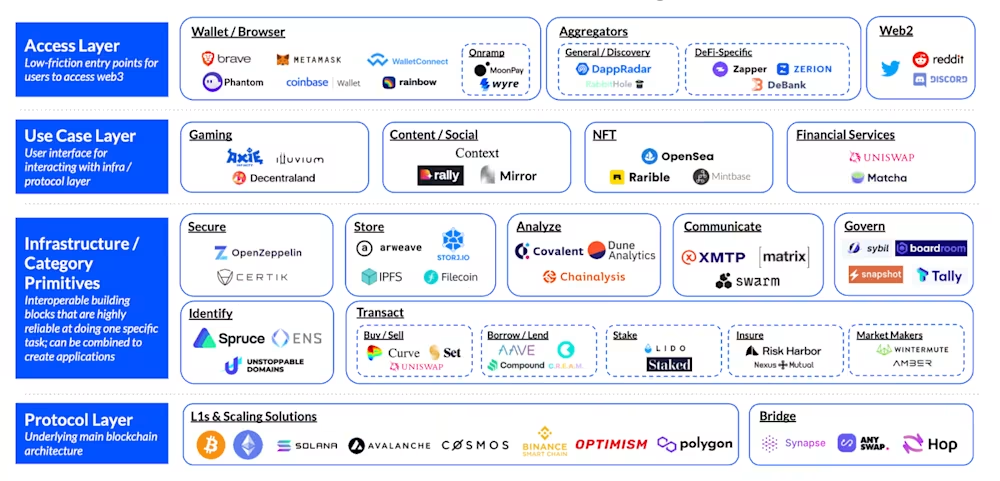
The web3 stack is like a toolkit for building the decentralised internet. It's a collection of protocols, infrastructure, and applications that work together to create new business models and organisational structures. Below is one of the best visual representations of the web3 tech stack:
Protocol Layer
At the bottom sits the protocol layer, which includes the blockchain foundations like Bitcoin, Ethereum, and their Layer 2 extensions. These provide the base infrastructure for everything else.
Cross-chain bridges also live here, acting like highways that allow value and data to move between different blockchain networks.
Infrastructure Layer
This dense layer contains the building blocks that developers use to create applications:
- File Storage: IPFS, Filecoin, Arweave for decentralised data storage.
- Oracles: Chainlink and others that bring real-world data onto the blockchain.
- Identity Solutions: ENS (Ethereum Name Service) domains and digital identity protocols.
- Financial Primitives: Uniswap for token swapping, Aave for lending.
Use Case Layer
Here's where everything comes together into actual applications. Games like Axie Infinity combine multiple infrastructure components to create engaging user experiences. Decentralised social platforms like Zora use storage protocols for content and blockchain for payments.
Access Layer
At the top, we have the entry points to web3: wallets, fiat on-ramps, and aggregator platforms that help users discover and interact with decentralised applications.
This layer is crucial because it determines whether web3 remains a niche technical curiosity or becomes accessible to mainstream users.
Consider all of these as Lego blocks for web3.
Key Takeaways
- The scalability trilemma is the fundamental challenge: No blockchain has perfectly solved security, decentralisation, and scalability simultaneously.
- Layers work in harmony: Functional layers create the complete system (the core components that make blockchain work), architecture layers solve scaling, and web3 stack layers provide the building blocks and enable innovation.
- Layer 2 solutions are game-changers: They provide scalability without compromising Layer 1's security and decentralisation.
- The future is multi-layered: Instead of one perfect blockchain, we're building an interconnected ecosystem of specialised networks.
- Innovation happens at every layer: Each layer presents opportunities for optimisation and new business models.
Final Thought
And there you have it! We've just taken apart the engine of web3 and examined every component. I know it's quite techy, but I hope you've got the point. Feel free to drop me a line on Telegram if you'd love to discuss this topic further.
What you need to remember is that blockchain is an entire architecture stack that's more complex than most people realise.
We're living through the phase of web3, similar to the early internet. Today's Layer 2 solutions and cross-chain bridges are tomorrow's foundational infrastructure that will power applications we can't even imagine yet.
The beautiful thing about understanding these layers is that you start seeing opportunities everywhere. Don't let the complexity overwhelm you. Rome wasn't built in a day, and neither is the decentralised internet. Web3's architecture will keep evolving, and that's exactly what makes this space so damn exciting.
If you learnt something new today, pass it on. Share it with your community. Let’s spread the knowledge and level up together.
That's a wrap, normies. Next time, we're diving into consensus mechanisms and exploring how different blockchains achieve agreement in a trustless world. Get ready for another mind-expanding journey 💪
Cookies She Left Behind
If you'd love to dig deeper into the topic, I'd also recommend reviewing the below:
- A simple guide to the Web3 stack (Coinbase Blog)
- A Developer’s Guide to the Web3 Stack (Alchemy Blog)