


Hey you!
Welcome back to “that’s what she said”, the newsletter where we unpack blockchain's biggest mysteries one byte at a time. Last time, we explored the world of consensus mechanisms, where thousands of strangers somehow agree on the same truth (if you missed that piece, pause here and catch up before we dive into today's topic).
Today, we're tackling one of blockchain's most revolutionary inventions — smart contracts. Imagine making an agreement that doesn’t rely on lawyers, middlemen, or memory. Instead, it’s enforced by tireless digital referees that never sleep, never take bribes, and never “forget” the rules. These aren't just databases or clever programs; they're autonomous pieces of code that can hold billions of dollars, execute complex financial operations, and coordinate entire economies without human intervention.
We're living through the birth of programmable trust, where code becomes law. Curious how computers learned to keep their word? Let’s get into it.
🧠 Definition
Imagine this: you're dealing with someone you've never met, buying something valuable, and there's no middleman to ensure you both play fair. Sounds risky, right? That's where smart contracts can help — the blockchain's solution to the trust problem.
A smart contract is a self-executing computer code stored on a blockchain that automatically enforces and executes agreements when predetermined conditions are met. Unlike traditional contracts that rely on legal systems and human interpretation, smart contracts are programs that run exactly as coded, every single time.
Think of them as digital vending machines for complex agreements. Just as a vending machine automatically dispenses your snack when you insert the right amount of money, a smart contract automatically executes its terms when specific conditions are satisfied. The key difference is that these digital agreements can handle infinitely more complex scenarios than "insert coins, receive candy".
Smart contracts eliminate the need for intermediaries by encoding trust directly into code. They're transparent (anyone can verify what they do), immutable (they can't be changed once deployed), and autonomous (they run without human intervention).
💪 How Smart Contracts Work
Smart contracts operate on simple "if/when X happens, then execute Y action" logic, but they can combine multiple conditions to create sophisticated automated systems.
When you deploy a smart contract to a blockchain, it becomes a permanent piece of code with its own address, like a digital post box that can receive and send transactions. Every node in the network stores a copy of this contract and its current state, creating a distributed system where no single party controls the outcome.
When someone interacts with a smart contract (by sending a transaction to its address), every node in the network simultaneously executes the contract's code. They all process the same inputs and, because the code is deterministic, they all reach the same result. This consensus ensures the contract executes correctly without requiring trust between parties.
For example, imagine a simple insurance smart contract for flight delays. The contract monitors flight data through external sources (called oracles), and if a flight is delayed by more than two hours, it automatically pays out compensation to the wallet address of the policyholder. No claims forms, no waiting periods, no human decisions — just code executing exactly as programmed.
The beauty lies in the automaticity: once conditions are met, execution is guaranteed. The contract follows its programming religiously, creating unprecedented reliability in digital agreements.
🔍 Origin
The story begins in 1994, when American computer scientist Nick Szabo first proposed the concept. Szabo, who also conceptualised a digital currency called bit gold (making him a frequent suspect for the mysterious Satoshi Nakamoto identity), defined smart contracts as "computerised transaction protocols that execute the terms of a contract".
Szabo's vision was revolutionary: extend electronic transaction methods beyond simple payments to create self-enforcing digital agreements. He even predicted complex derivatives and securities trading through automated contracts.
But brilliant ideas need the right infrastructure. For decades, smart contracts remained theoretical because the technology didn't exist to make them work reliably. The missing pieces were decentralisation (no single point of control), immutability (contracts couldn't be tampered with), and consensus (everyone had to agree on outcomes).
Bitcoin, launched in 2009, provided the first glimpse of programmable money with basic smart contract functionality. Multi-signature transactions, introduced in 2012, allowed multiple parties to control Bitcoin wallets, a simple but powerful smart contract application.
The real breakthrough came in 2013 when 19-year-old Vitalik Buterin published the Ethereum whitepaper. While Bitcoin functioned like a single smart contract application, Buterin envisioned a world computer that could run thousands of different smart contracts simultaneously.
Ethereum launched in 2015 and transformed smart contracts from an interesting concept into a global phenomenon. Suddenly, developers could build complex financial applications, games, and decentralised organisations using smart contract building blocks. The rest, as they say, is history worth trillions of dollars.
👀 Advantages and Limitations
Smart contracts represent a fundamental shift in how agreements work, bringing unprecedented benefits alongside unique challenges.
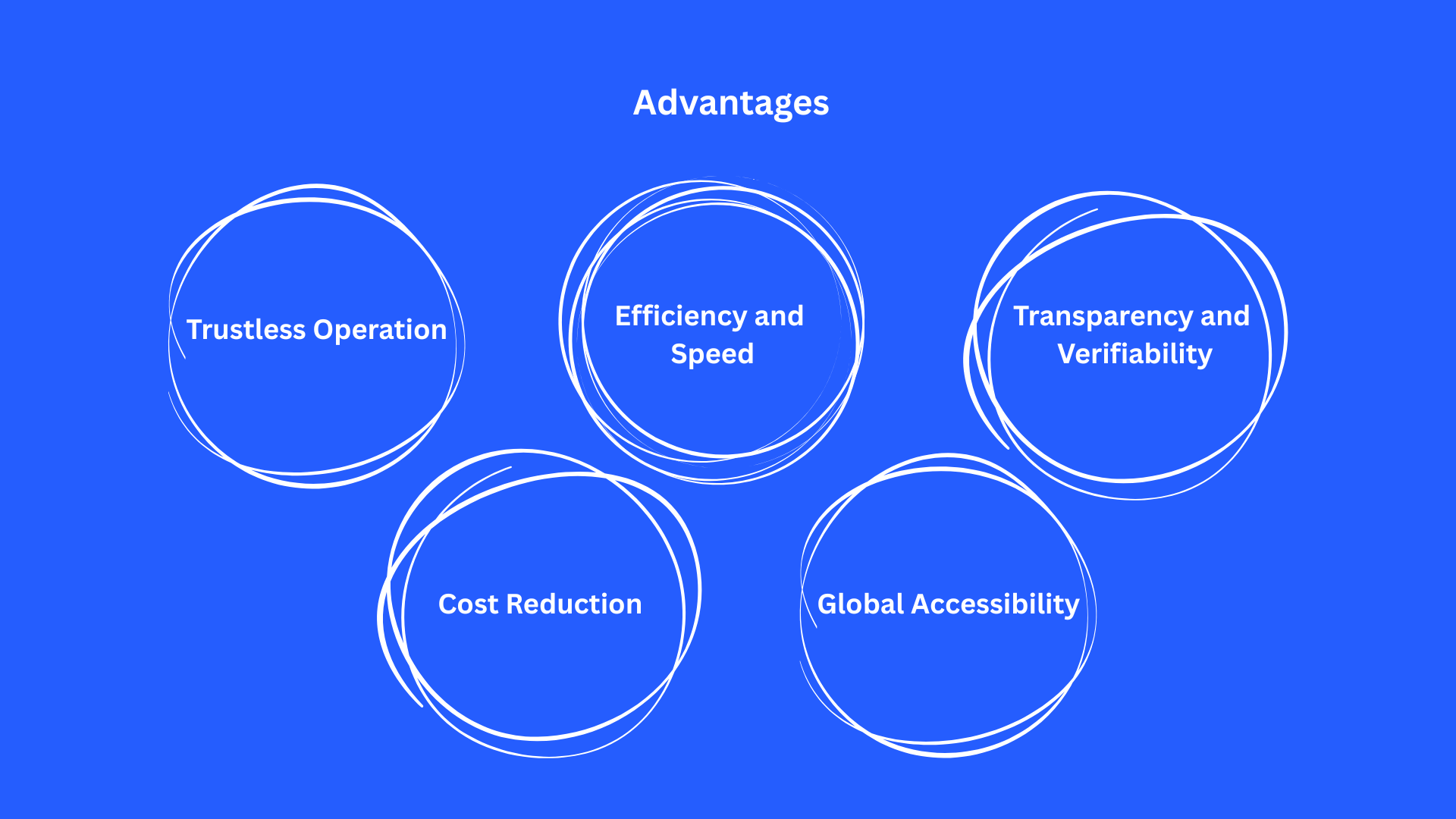
- Trustless Operation: The most revolutionary aspect is the elimination of counterparty risk. You don't need to trust the other party or rely on intermediaries, as the code guarantees execution.
- Efficiency and Speed: Traditional contracts often involve lawyers, extensive paperwork, lengthy waiting periods, and manual processes. Smart contracts execute instantly when conditions are met, automating everything from escrow to settlement. What takes weeks in traditional finance happens in minutes on blockchain.
- Transparency and Verifiability: Smart contracts are mostly open source. Anyone can inspect the code to understand exactly how it works before interacting with it. This transparency creates accountability, which is impossible with traditional closed agreements.
- Cost Reduction: By eliminating intermediaries like banks, lawyers, and brokers, smart contracts dramatically reduce transaction costs. Instead of paying multiple parties to facilitate an agreement, you pay only network fees to execute the contract.
- Global Accessibility: Smart contracts work identically everywhere, 24/7. Geographic boundaries, business hours, and local regulations don't matter because the code runs the same way for everyone, creating truly global financial infrastructure. However, it's necessary to note that while protocols are permissionless, front-ends aren’t — UI access can be restricted even if the on-chain protocol is open.
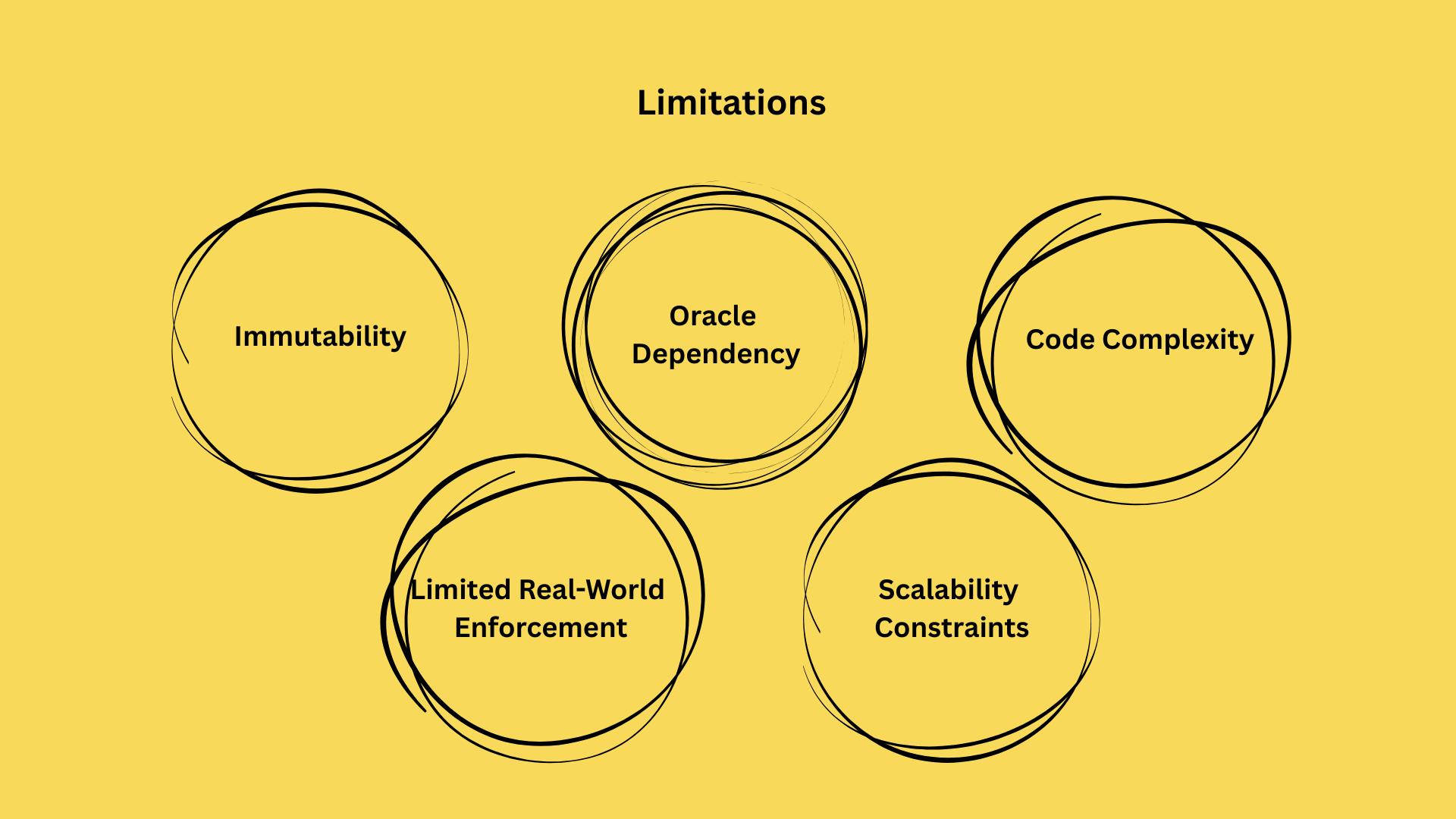
- Immutability: The same permanence that makes smart contracts trustworthy also makes them dangerous. Bugs in deployed contracts can't be easily fixed, and there's no "undo" button for mistakes. This has led to massive losses when exploits are discovered post-deployment.
- Oracle Dependency: Blockchains are isolated systems that can't directly access external data. Smart contracts rely on oracles to provide real-world information, creating potential points of failure and manipulation. If the oracle lies, the contract acts on false information.
- Code Complexity: Writing secure smart contract code is extremely difficult. Even small programming errors can have catastrophic consequences when millions of dollars are at stake. The code is law principle means bugs become permanent features until the contract is replaced.
- Limited Real-World Enforcement: Smart contracts excel at managing digital assets but struggle with physical world interactions. They can't force someone to deliver goods, appear in court, or comply with regulations: they only control what happens on the blockchain.
- Scalability Constraints: Popular smart contract platforms like Ethereum can become congested, leading to high fees and slow transaction times.
Important Note! Smart contracts are mostly immutable once deployed, but plenty of projects use clever patterns (proxies, upgradable contracts, governance-controlled logic) to give themselves wiggle room. So now we have proxy contracts where the contract you interact with points to an implementation that can be swapped. You can read more about this in the section Cookies She Left Behind.
🎯 Use Cases
Smart contracts have evolved from simple payment automation to powering entire digital economies. Here are the most transformative applications:
- Decentralised Finance (DeFi): The crown jewel of smart contract applications. DeFi protocols like Uniswap enable automated trading without centralised exchanges, while platforms like Compound, Aave and Morpho allow lending and borrowing without banks.
- Supply Chain Management: Companies use smart contracts to track products from manufacture to delivery, automatically triggering payments when goods reach specific checkpoints. This creates transparency and accountability across global supply chains.
- Insurance: Parametric insurance policies that pay out automatically based on measurable events. Flight delay insurance pays when flights are late.
- Digital Identity and Credentials: Smart contracts can verify and manage digital identities, educational credentials, and professional certifications without relying on centralised authorities. This creates portable, verifiable credentials that work globally.
- Real Estate: Property sales can be automated through smart contracts that handle escrow, title transfers, and payment distribution. This reduces closing times from weeks to minutes and eliminates much of the associated paperwork.
- Gaming and NFTs: Smart contracts power play-to-earn gaming economies and non-fungible token (NFT) marketplaces, creating new forms of digital ownership and value creation.
- Decentralised Autonomous Organisations (DAOs): Entire organisations governed by smart contracts, where decisions are made through token-based voting and executed automatically. These represent new forms of corporate governance and collective decision-making.
💻 Programming Languages for Smart Contracts
The smart contract development landscape has matured significantly, with several languages dominating different blockchain ecosystems:
- Solidity: Still the undisputed king of smart contract languages. Solidity remains the most widely used programming language for smart contracts, primarily on Ethereum and EVM-compatible blockchains. Its syntax resembles JavaScript and C++, making it accessible to many developers. The vast majority of DeFi protocols are built with Solidity.
- Rust: Rust is known for its performance and has become the go-to language for high-performance blockchains like Solana. Its memory safety features make it excellent for building secure, efficient smart contracts.
- Vyper: Vyper, a security-focused alternative with Python-like syntax, has gained traction for developers prioritising security over complexity. Solidity and Vyper are the two powerhouses in smart contract development today, with languages like Vyper and Move offering enhanced safety features.
- Move: Developed by Meta for the Diem project, Move has found new life in blockchains like Aptos and Sui. Move offers enhanced safety features with its resource-oriented programming model that makes certain classes of bugs impossible.
- Cairo: Used for scaling solutions and zero-knowledge proofs, particularly on StarkNet. Rust and Cairo are great for performance-intensive applications. It enables complex computations while maintaining scalability and reducing costs.
- Yul: Yul is a low-level intermediate language for Ethereum that supports the EVM. Built to translate straightforwardly to bytecode, Yul excels at optimising contract performance for gas efficiency.
The choice of language increasingly depends on your specific needs:
- Security: Languages like Vyper and Move offer enhanced safety features.
- Performance Needs: Rust and Cairo are great for performance-intensive applications.
- Tooling & Community: Solidity has the most mature ecosystem, while newer languages may have fewer resources.
Key Takeaways
- Smart contracts are revolutionary: They represent the first time in history we can create truly trustless agreements between strangers, eliminating the need for intermediaries and central authorities.
- Code is law: The immutable nature of smart contracts means bugs become permanent features. This makes security auditing and careful development crucial for any serious application.
- The oracle problem persists: While smart contracts excel at managing on-chain assets, connecting to real-world data remains challenging and creates potential vulnerabilities.
- DeFi leads innovation: Decentralised finance applications showcase the most mature and valuable smart contract use cases, processing hundreds of billions in transactions annually.
- Platform choice matters: Different blockchains offer different trade-offs between speed, cost, security, and decentralisation. Ethereum dominates mindshare, but alternatives are gaining ground rapidly.
Final Thought
Smart contracts represent one of humanity's most ambitious experiments in digital trust. We've created code that can hold billions of dollars and coordinate global networks without human intervention.
What's remarkable isn't just the technology, but what it reveals about human nature. We've built systems so transparent that every line of code is public, so reliable that they never sleep, and so impartial that they treat everyone identically. Yet every bug reminds us that perfection in code is as elusive as perfection in law.
Every DeFi transaction and DAO vote is a small experiment in how humans can coordinate value in ways that would have been impossible just a decade ago.
If you learnt something new today, pass it on. Share it with your community. Let’s spread the knowledge and level up together.
That's a wrap, normies. Next time, we'll talk about oracles and their role in providing blockchains with real-world data. Stay tuned 👀
Cookies She Left Behind
If you'd love to dig deeper into the topic, I'd also recommend reviewing the below:
- What are Smart Contracts in Crypto? by Whiteboard Crypto
- An Introduction to Upgradeable Smart Contracts by QuickNode