


Hey you!
Welcome back to “that’s what she said”, the newsletter which is your reliable biweekly guide through the web3 wilderness. Last time, we explored forks — those blockchain splits that represent democracy in action, crypto-style (if you missed it, go back and read it before diving into today's topic).
Today, we're discussing something way less dramatic but infinitely more useful in your day-to-day crypto life: block explorers. These are your personal search engines for the blockchain, your window into every transaction, every wallet, and every block that has ever existed on the network.
You've probably used one before, maybe when you sent crypto to someone and panicked because they didn't see it immediately, or when you wanted to verify that your transaction actually went through. Block explorers are like the receipt printers of the crypto world, except instead of just showing your purchase, they show literally everything that's happening on the blockchain.
Ready? Let's yap on this topic!
🧠 Definition
In the simplest terms, a block explorer is an online search engine specifically designed for blockchain data. It's a tool that translates raw, cryptographic blockchain information into something humans can read and understand. Think of it as Google, but instead of searching the internet, you're searching through every transaction, block, and wallet address on a specific blockchain.
Here's a better analogy: imagine the blockchain as a massive public library where every book is a permanent record of transactions. The books are written in a language only computers understand. A block explorer is like having a translator who can find any book in the library, open it to any page, and explain exactly what's written there in plain language.
The critical thing to understand: block explorers don't control or modify anything on the blockchain. They're read-only tools. They access the publicly available data that's already there and present it in a way that doesn't require a computer science degree to understand. Every transaction that has ever happened on Bitcoin, Ethereum, or any other blockchain is permanently recorded and publicly visible. Block explorers make that visibility accessible.
One more thing: block explorers are free to use. You don't need an account, you don't need permission, and you don't need to pay. Just open one up and start searching. That's the power of blockchain transparency in action.
💡 Importance
Block explorers embody one of crypto's core principles: don't trust, verify. In traditional finance, you have to trust your bank when they say your money is there or that your transfer went through. In crypto, you can verify everything yourself.
- Verification without intermediaries. Sent Bitcoin to someone? Don't wait for them to confirm receipt — paste your transaction ID into a block explorer and watch it get confirmed in real-time. Running a business that accepts crypto? Verify payments instantly without trusting any third party.
- Transparency creates accountability. Every transaction is permanent, public, and verifiable. Want to verify that a charity actually received the donations they claim? Check the wallet address on a block explorer.
- Educational value. Block explorers are incredible learning tools. By clicking around and exploring transactions, you develop an understanding of how blockchains actually work. You can see the gas fees people are paying, watch blocks getting mined in real-time, and observe network congestion firsthand. It transforms abstract concepts into concrete, observable reality.
- Troubleshooting. When something goes wrong with a crypto transaction, a block explorer is your first diagnostic tool. Did your transaction fail? Check the explorer. Is it still pending? The explorer shows exactly how many confirmations it has. Did you accidentally send it to the wrong address? The explorer will confirm your worst fears, but at least you'll know.
- Monitoring and research. Investors use block explorers to track whale movements, monitor wallet addresses associated with major holders, and analyse on-chain activity. Developers use them to inspect smart contracts and debug issues. Researchers use them to study network behaviour and transaction patterns. The blockchain's permanent record reveals patterns that would be hidden in traditional systems.
If you're active in crypto and you're not using block explorers, you're flying blind. They're essential infrastructure for anyone who wants real control over their crypto activity.
⚙️ How Block Explorers Work
Block explorers operate through blockchain nodes (as we remember, they are computers that maintain complete copies of the blockchain and validate transactions). The explorer connects to one or more nodes (or runs its own) and continuously retrieves the latest blocks and transactions as they're added to the chain.
Data pipeline
Every blockchain consists of a chain of blocks, where each block contains a bundle of transactions. This data is public and distributed across thousands of nodes worldwide, but it's stored in a format optimised for computers. Block explorers act as intermediaries, pulling this raw data from nodes and converting it into a searchable, visual interface.
Each blockchain needs its own explorer
Here's something crucial: you can't use a Bitcoin block explorer to search Ethereum transactions. Each blockchain needs its own explorer because blockchains are independent systems with different data structures, transaction formats, and features. That means each one requires specialised tools to read and display what’s happening on-chain. For example, Ethereum explorers like Etherscan handle smart contract interactions, while Bitcoin explorers focus on simpler transaction tracking. Since blockchains don’t share protocols or data formats, one explorer simply can’t read data from another chain.
Real-time updates
Most block explorers update continuously, showing new transactions and blocks as they happen. When a new block is mined or validated, the explorer pulls that data within seconds and displays it. This is why you can watch your transaction move from "pending" to "confirmed" in real-time.
APIs for developers
Beyond the visual interface, most explorers provide APIs (Application Programming Interfaces) that allow developers to programmatically access blockchain data. This enables the creation of wallets, analytics tools, and applications that need to read blockchain information without building their own node infrastructure.
💪 Pros & Cons
Block explorers are incredibly useful, but they're not without limitations. Let's break down both sides.
Advantages:
- Complete transparency. You can verify anything that happens on the blockchain yourself, 24/7. No need to trust exchanges, wallets, or anyone else's word about what happened to your crypto.
- Free and accessible. Almost all block explorers are completely free to use. No account required, no subscription fees, no paywalls. This democratizes access to blockchain data.
- Educational powerhouse. By exploring real transactions, you learn how blockchains actually work. Concepts like gas fees, confirmations, and network congestion become tangible instead of abstract.
- Essential for troubleshooting. When transactions don't behave as expected, block explorers help you diagnose the issue. Is it still pending? Did it fail? Was the fee too low? The explorer answers these questions instantly.
- Accountability and auditing. Projects can prove their transparency by sharing wallet addresses. Users can verify claims about token burns, charity donations, or treasury reserves by checking the blockchain directly.
Disadvantages:
- Can be overwhelming. Especially for beginners, block explorers look intimidating. You're confronted with cryptographic hashes and hexadecimal addresses. The learning curve is real.
- Privacy concerns. Everything is public. If you use the same wallet address repeatedly, anyone can see your complete transaction history, balance, and holdings. Privacy coins and new addresses for each transaction help, but the default is total transparency.
- Technical knowledge required. Understanding smart contract interactions, internal transactions, or token approvals requires some technical background. You can see the data, but interpreting it correctly is another matter.
- Not always real-time. Some explorers lag during periods of high network congestion. Smaller or newer blockchains might have less reliable explorers that don't update as quickly.
- Dependence on third parties. While the blockchain itself is decentralised, most people access it through centralised block explorer websites. If that site goes down or gets compromised, you temporarily lose visibility (though the blockchain itself keeps running fine).
- No reversal. Block explorers will coldly confirm that yes, you did send your life savings to the wrong address, and no, there's absolutely nothing anyone can do about it.
The benefits massively outweigh the drawbacks for anyone serious about crypto. Yes, they can be confusing at first, and yes, the lack of privacy is concerning, but the ability to verify everything yourself is worth the trade-offs.
👀 How to Use a Block Explorer
Using a block explorer is straightforward once you understand what you're looking for. Let's walk through the basics.
The search bar is your starting point. When you open a block explorer like Etherscan, Blockchain.com, or any other, you'll see a prominent search bar. This is where you enter one of three things:
- Transaction hash (TxID): A unique string of letters and numbers generated for every transaction. Use this when you want to check if a specific transfer was successful or see its details.
- Wallet address: A public key address that lets you view all transactions associated with that wallet, its balance, and token holdings.
- Block number: The position of a specific block in the blockchain. Useful when you want to see all transactions that were included in a particular block.
Important: Never enter your private key into a block explorer. Only use public addresses. Your private key should remain secret.
Understanding transaction data. When you search for a transaction hash, you'll see several key details:
- Status: Tells you if the transaction is confirmed (successful), pending (waiting to be included in a block), or failed (rejected by the network).
- Confirmations: How many blocks have been added to the chain since your transaction was included. More confirmations mean higher security and irreversibility.
- Timestamp: When the transaction was added to a block.
- From/To: The sender and receiver wallet addresses. Note: these are addresses, not names, though some are labelled by the explorer (like "Binance: Cold Wallet").
- Value: The amount of cryptocurrency transferred.
- Transaction Fee (Gas): The fee paid to miners or validators for processing the transaction.
Exploring wallet addresses. Searching for a wallet address gives you a complete financial history:
- Balance: The current amount of cryptocurrency held.
- Token holdings: A list of other tokens (ERC-20 on Ethereum, BEP-20 on Binance Smart Chain, etc.) held in the wallet.
- Transaction history: Every incoming and outgoing transaction in chronological order.
Everything is public. Anyone can see any wallet's complete history. This is transparency in action, but it's also why privacy matters if you're using the same address repeatedly.
Block data. Looking up a specific block shows:
- Block height: The position of the block in the blockchain (block #1 is the genesis block).
- Miner/Validator: Who created the block and received the reward.
- Number of transactions: Total transactions bundled in that block.
- Block reward: The cryptocurrency reward given to the miner or validator.
- Timestamp: When the block was added to the chain.
Network statistics. Most block explorers also provide high-level network data on their homepage:
- Current hashrate: Total computational power securing the network (for Proof-of-Work chains).
- Transaction volume: How many transactions are happening.
- Average block time: How long it takes to mine or validate new blocks.
- Mempool size: Transactions waiting to be included in the next block.
- Fee estimates: Suggested transaction fees based on current network congestion.
Bookmark the block explorer for the chains you use most frequently. When you send a transaction, immediately copy the transaction hash and paste it into the explorer to monitor its progress.
🔥 Popular Block Explorers
While they all serve the same basic purpose, some block explorers have better interfaces, more features, or stronger brand recognition. Here are five popular ones you'll likely encounter:
- Etherscan (Ethereum). The gold standard for Ethereum and the name almost everyone in crypto recognises. Etherscan offers a polished, user-friendly interface with powerful features like smart contract verification, token tracking, gas trackers, and detailed analytics. If you're doing anything on Ethereum, you'll inevitably end up on Etherscan. It's also been cloned for other EVM-compatible chains (BscScan, Polygonscan, Arbiscan), so learning Etherscan means you can navigate most other EVM explorers too.
- Blockchain.com (Bitcoin). One of the oldest and most trusted Bitcoin block explorers. Blockchain.com offers a clean interface that's perfect for beginners checking Bitcoin transactions. Beyond the explorer, they also provide wallet services and market data, making it a one-stop shop for Bitcoin users. The homepage displays real-time network statistics, recent blocks, and a helpful charts section for analysing Bitcoin activity over time.
- Blockchair (Multi-chain). The Swiss Army knife of block explorers. Blockchair supports multiple blockchains under one roof — Bitcoin, Ethereum, Litecoin, Dogecoin, and more. This makes it incredibly useful when you're working across different chains and don't want to juggle multiple bookmarks. It also offers advanced filtering and sorting options that power users appreciate.
- Solscan (Solana). The go-to explorer for the Solana ecosystem. Solscan provides a clear overview of SOL transactions, NFT activity, and smart contract interactions specific to Solana's high-speed architecture. Given Solana's different structure compared to Bitcoin or Ethereum (it uses Proof of History), having a dedicated explorer that understands its unique features is essential.
- BscScan (Binance Smart Chain). Built on the same framework as Etherscan but specifically for Binance Smart Chain. BscScan offers similar functionality to its Ethereum cousin — smart contract verification, token tracking, and detailed transaction data. If you're trading on PancakeSwap or using any BSC-based DeFi protocols, BscScan is where you'll verify everything.
Most explorers look similar in layout because they're solving the same problem. Pick the one that matches the blockchain you're using, bookmark it, and learn its interface. The skills transfer across different explorers surprisingly well.
🔍 Reading a Real Transaction
Let's walk through what you'd actually see when checking a transaction on a block explorer. We'll use an Ethereum transaction as an example.
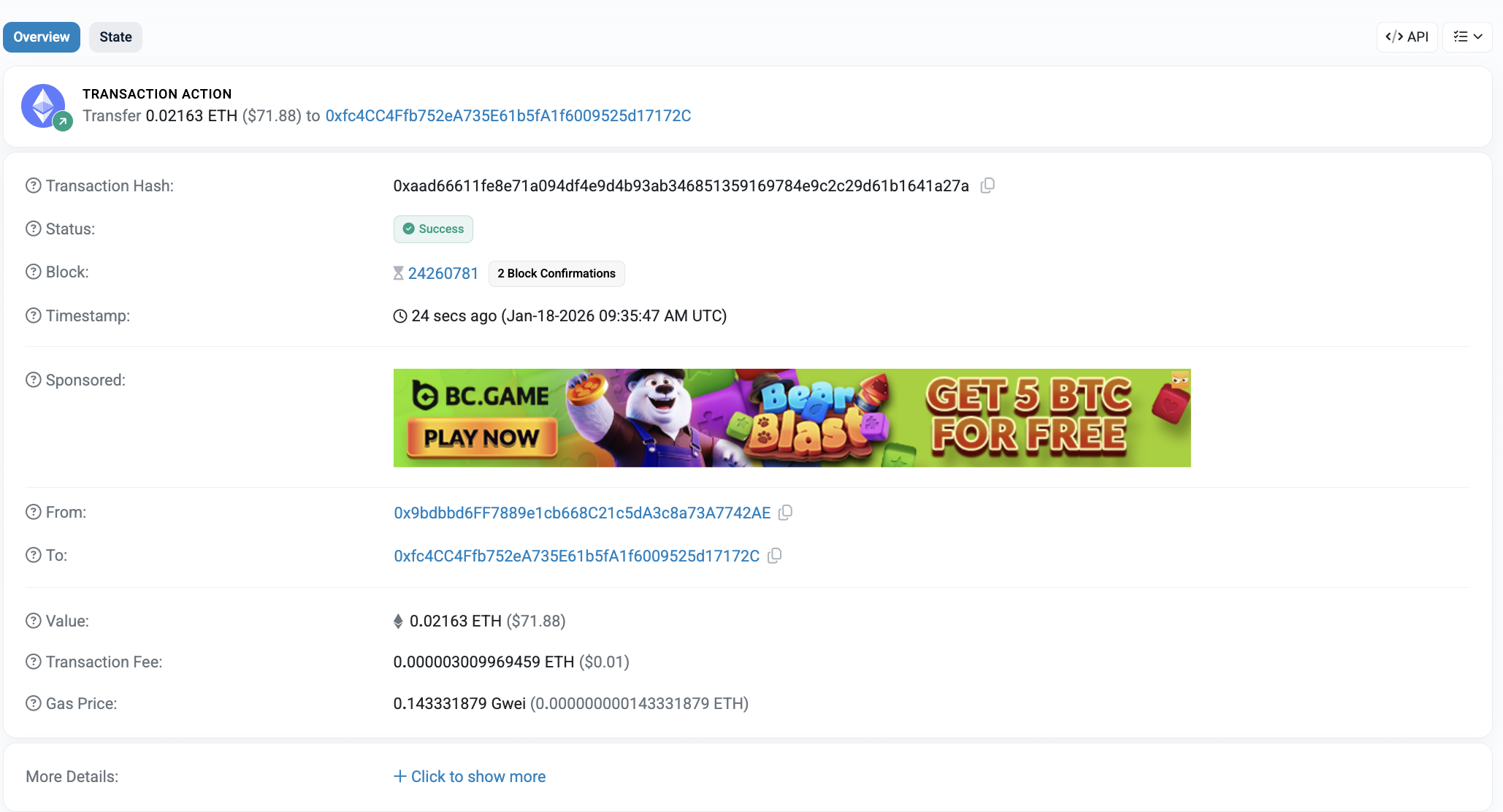
According to the screenshot, someone sent 0.02163 ETH (about $71.88) from one Ethereum wallet to another. The transaction went through and is confirmed on-chain (Status: ✅ Success).
We also see the transaction hash (the transaction's unique ID), block information (included in block #24,260,781; it already has 2 confirmations, meaning other blocks were added after it, making the transaction increasingly final) and a timestamp (the transaction happened 24 seconds ago at the time of the screenshot).
Below we can also see the sender's and the recipient's wallet addresses and the information regarding the crypto sent:
- Value sent: 0.02163 ETH (~$71.88)
- Transaction fee (gas): 0.00000301 ETH (about $0.01). That’s cheap, probably a quiet network moment.
- Gas price: 0.143 Gwei (very low, which explains the tiny fee).
Key Takeaways
- Block explorers are search engines for blockchains. They translate raw blockchain data into human-readable information, letting anyone verify transactions, balances, and network activity.
- Each blockchain needs its own explorer. Bitcoin, Ethereum, Solana, and others all have unique data structures and transaction formats. You can't use one explorer for multiple chains (though some websites host multiple explorers).
- Transparency is the superpower. Block explorers embody crypto's "don't trust, verify" philosophy. You can check anything yourself without relying on intermediaries or taking anyone's word for it.
- They're essential tools. If you're sending crypto, accepting payments, or investing seriously, block explorers should be part of your regular workflow. They're free, accessible, and incredibly powerful.
- Privacy is limited. Everything is public. Anyone can see any wallet's complete history, which is great for transparency but concerning for privacy. Consider using different addresses for different purposes.
- The learning curve is worth it. Block explorers look intimidating at first, but once you understand the basics, they become indispensable tools that give you real control over your crypto activity.
Final Thought
Your bank sees everything; you see what they choose to show you. You trust them to maintain accurate records, process transfers correctly, and protect your money. That trust gets violated regularly through fees, delays, and "technical difficulties" that always seem to benefit the bank.
Block explorers flip this model completely. Every transaction is public, permanent, and verifiable by anyone. No one can hide fees in fine print, delay transfers for days, or claim your payment didn't go through.
They're your personal auditors, working 24/7, never charging a fee, never asking for credentials. They're what accountability looks like when built into the system rather than bolted on as an afterthought.
So next time you send crypto and that familiar panic sets in, don't spiral. Open a block explorer. Paste your transaction hash. Watch the confirmations roll in. That's what financial sovereignty feels like.
If you learnt something new today, pass it on. Share it with your community. Let's spread the knowledge and level up together.
That's a wrap, normies. Next time, we'll talk about hash functions and Byzantine fault tolerance. Stay tuned ✨
Cookies She Left Behind
If you'd love to dig deeper into the topic, I'd also recommend reviewing the following:
- How To Use and Read Etherscan In 10 Minutes by decryptoverse
- List of Block Explorers by Alchemy